


Steel vs wood: which building material wins? Wood and steel are the two most common materials for any building project, and the choice deserves real consideration rather than defaulting to whichever looks cheaper on paper. Over the life of a building, steel typically comes out ahead on total cost, durability, and construction speed — here’s the detailed comparison. Whether you’re weighing steel vs wood for a garage, barn, or shop, the same factors apply.
Key takeaways
- Wood is cheaper upfront, not overall. Its lower price is often deferred maintenance.
- Steel resists rot, mold, fire and pests. The risks that age a wood building.
- Steel goes up faster. Precision-cut parts arrive ready to bolt together.
- Insurance may cost less. Ask your insurer about non-combustible construction.
Side-by-side comparison
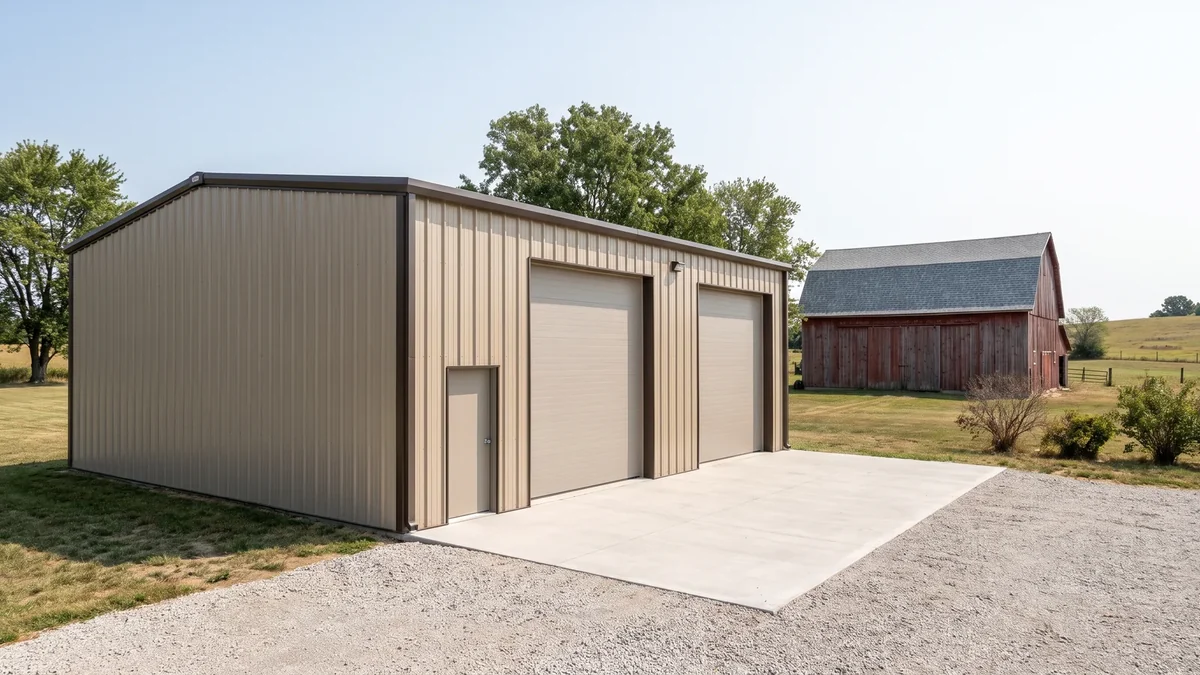
| Factor | Wood | Steel |
|---|---|---|
| Upfront cost | Lower | Higher |
| Long-term cost | Ongoing repairs and maintenance | Minimal maintenance required |
| Durability | Prone to warping, cracking, rotting | Resists wind, snow, fire, and pests |
| Material consistency | Quality varies — up to 20% of lumber can go to waste | Consistent, engineered strength |
| Construction time | Raw lumber cut and fabricated on-site | Precision-manufactured to exact measurements, pre-drilled |
| Customization | Traditional aesthetic, high maintenance to preserve it | Wide color range; end walls can still use brick, wood, or vinyl |
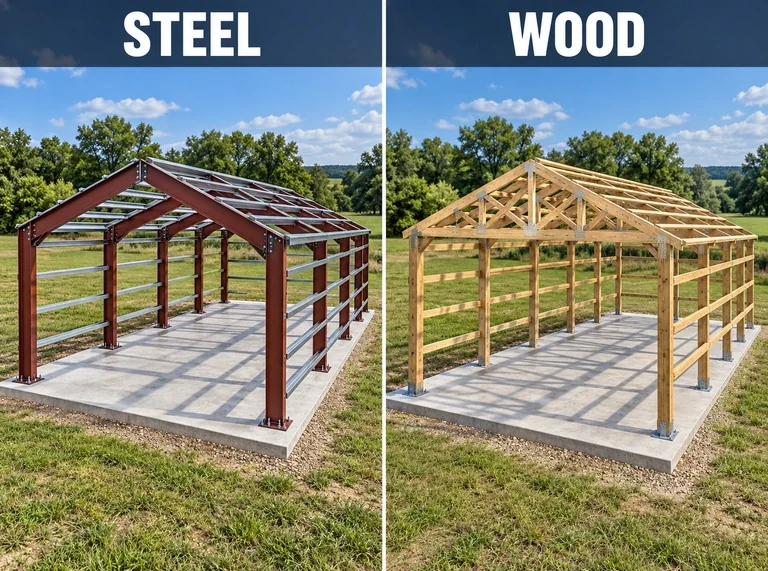
7 reasons steel beats wood
The steel vs wood debate in short.
1. Lower long-term cost
Less repair and maintenance over the building's life.
2. Durability
No warping, cracking or rotting.
3. Mold and moisture resistance
No organic material for mold to grow on.
4. Faster construction
Precision-manufactured, pre-drilled parts.
5. Consistent quality
Engineered strength without lumber waste.
6. Fire and pest resistance
Non-combustible and termite-proof.
7. Potential insurance savings
Fewer of the risks insurers price in.
Why "cheaper upfront" isn't the full story
Wood naturally deteriorates over time, and the resources needed to repair and maintain it in good condition often outweigh the cost difference of building with steel in the first place. If you have long-term plans for the building, steel makes more financial sense the moment you look past the initial price tag — a wood structure’s lower sticker price is really just deferred cost, paid later in repainting, sealing, and repairs rather than avoided entirely.
Steel vs wood over 30 years
What ownership really looks like.
| Over the years | Wood building | Steel building |
|---|---|---|
| Years 1 to 5 | Settling, sealing and first touch-ups | Little or no maintenance |
| Years 5 to 15 | Repainting, rot repairs, pest treatment | Occasional cleaning and fastener checks |
| Years 15 to 30 | Replacing posts, siding or roof framing | Paint warranty of 25 to 40 years on straight-wall panels |
| Resale | Condition often declines | Holds its appearance and structure |
General comparison. Actual costs vary by climate and care.
Durability: not just about strength
Wood is genuinely tough, but it’s prone to warping, cracking, rotting, and bending from moisture, pests, and age — and inconsistent lumber quality can waste up to 20% of the material while creating weak points in the structure. Steel doesn’t share these vulnerabilities: it’s fire-resistant, pest-resistant, and engineered by Toro’s in-house team to weather your specific site’s wind and snow loads consistently, rather than a generic regional average.
Mold, fungus and moisture
Wood absorbs moisture quickly, making it vulnerable to rot and mold growth wherever moisture gets trapped inside wall cavities or framing — a problem that can develop unseen for months before it’s discovered, by which point structural members may already be compromised. This isn’t just a durability issue: mold and mildew growth can cause allergic reactions and respiratory problems in both humans and animals, which matters directly for agricultural buildings housing livestock. Steel doesn’t provide the organic material mold needs to grow in the first place, and its natural moisture resistance removes this entire category of risk rather than just managing it.
Steel still needs insulation and ventilation to control condensation; see 7 ways to prevent condensation.
Fire and pests
Two risks steel takes off the table.
Wood framing is fuel: once it catches, it burns, and a fire can spread through a wood building quickly. Steel is non-combustible, so it won't ignite or add fuel to a fire, which matters most in buildings that store hay, fuel, vehicles or equipment. Termites, carpenter ants and rodents that damage wood have nothing to eat in a steel frame. In wildfire-prone regions, steel can also help with insurance costs. Like any structural material, steel loses strength in an intense, sustained fire, so fire safety habits still matter.
Construction timeframe
Wood often arrives as raw lumber, requiring on-site cutting and fabrication into the building’s frame — real time and labor cost. Steel arrives precision-manufactured to exact measurements with holes pre-drilled, cutting both construction time and labor costs, which matters especially for commercial buildings where faster completion means an earlier return on investment.
Toro buildings are precision laser-cut and arrive ready to bolt together, so construction is typically 30 to 50% faster than conventional wood framing, which is cut piece by piece on site.
Customization without the maintenance tradeoff
Wood’s traditional aesthetic appeals to many, but preserving it demands constant upkeep. Steel offers a wide range of customizable colors with minimal maintenance, and front/back end walls can still be built from brick, wood, or vinyl if you want a specific look — customized to match your exact use case without sacrificing steel’s low-maintenance core.
Insurance implications
Because steel is non-combustible and resists the pest, mold, and storm damage that insurers treat as real risk factors in a wood structure, a steel building can sometimes qualify for more favorable insurance rates than a comparable wood building — worth confirming with your provider, since policies vary by insurer and region. Over the life of the building, that potential savings compounds alongside the lower maintenance costs steel already offers.
Read more in why insuring a steel building costs less.
What maintenance really looks like
A year in the life of each building.
A wood building needs regular attention: checking for rot at the base of posts and siding, treating for termites and carpenter ants, repainting or restaining every few years, replacing warped boards and fixing doors that stick as the frame moves. A steel building's yearly routine is short: rinse off dirt and road salt, check fasteners and trim, clear gutters and touch up any scratch that reaches bare steel. Over a few decades, that difference in time and money is one of the clearest arguments in the steel vs wood debate. See maintaining your steel building.
Steel vs wood and the environment
Recyclable, efficient and long-lasting.
Steel is 100% recyclable without losing strength, and much of the steel produced today contains recycled content. Precision-cut kits waste very little material on site, unlike lumber, where offcuts and rejected boards add up. A building that lasts decades with little maintenance also avoids the repeated material use of repairs and replacements. If the building is ever taken down, its steel can be recycled rather than sent to landfill.
Where steel beats wood the most
Common buildings where the difference shows.
| Building | Why steel wins |
|---|---|
| Garages and shops | Low maintenance, fire resistance and clear span |
| Barns and farm buildings | No rot or pests; safer for hay and animals; see pole barn vs. steel barn |
| Storage buildings | Secure, dry and long-lasting; see metal storage sheds |
| Commercial buildings | Fast to build, so income starts sooner |
| Barndominiums | Open interiors and a durable shell; see barndominium plans |
When wood still makes sense
An honest look.
Wood can still be the right call for a very small shed, a project where a specific traditional look matters most, or interior framing inside a steel shell. Many steel buildings combine the two: a steel structure for strength and longevity, with wood or other finishes inside or on the end walls for warmth and style. The question isn't steel vs wood in every detail; it's which material carries the structure for the next several decades.
Steel vs wood for DIY builders
Which is easier to build yourself?
Building with wood means measuring, cutting and fitting every piece on site, and mistakes cost time and lumber. A Toro steel kit arrives with every component precision-cut, pre-drilled and labelled, plus an instruction manual specific to your building, so a handy owner with a few helpers can bolt it together. That's why so many owners choose steel vs wood for a DIY garage or shop. Read Jim's DIY story to see how it goes in practice.
Spans and open space
Why steel buildings feel bigger inside.
Steel's strength lets a frame span wide spaces without interior posts. Toro's red iron T-Model reaches clear spans up to 300 feet, while typical wood framing needs posts or heavy trusses for wide buildings. In a steel vs wood comparison for a shop, barn or arena, that open floor is often the deciding factor: equipment, vehicles and animals move freely, and the layout can change later without moving structural walls.
Common steel vs wood myths
What buyers often get wrong.
"Steel buildings rust."
Galvalume Plus steel resists corrosion, and straight-wall panels carry a 25 to 40-year paint warranty depending on panel and finish.
"Steel buildings are noisy and cold."
Insulation controls noise, temperature and condensation, just as it does in a wood building.
"Steel looks industrial."
Colours, trim, wainscot and end walls in brick, wood or vinyl give steel a residential or farm look.
"Wood is always cheaper."
Only upfront. Over decades, maintenance and repairs usually tip the balance to steel.
Steel vs wood in harsh climates
Snow, wind and freeze-thaw cycles.
In Canada and the northern U.S., freeze-thaw cycles and moisture accelerate wood rot, and heavy snow loads stress aging framing. A steel building engineered for its exact address under the National Building Code of Canada or ASCE 7 keeps its strength season after season. On hurricane-prone coasts, engineered steel framing and anchorage are designed for local wind loads.
Price your steel building
Tell us what you're building and where, and a building specialist will send a quote within 1 business day.
From quote to building
How a Toro steel building comes together.
- Design itPlan your steel building in the free 3D Building Designer or with a building specialist.
- EngineeringToro's in-house engineers design it for your address's snow, wind and seismic loads and stamp the drawings.
- PermitUse the stamped drawings to apply for your building permit.
- FoundationYou or your contractor build the foundation to the structural reactions Toro provides.
- Delivery and assemblyThe kit ships to your site, and you or a local contractor bolt it together. Toro doesn't install.
See steel buildings go up


Cost and pricing
What a steel building costs.
Toro's steel building kits start at $19 per square foot in the U.S. and $26 per square foot in Canada (CAD). Freight isn't included. Your size, options, intended use, and local snow, wind and seismic loads and codes set the final price, so every building needs a quote to make sure it meets the loads and codes where you'll build.
Compare that with the full cost of a wood building over its life, including maintenance, repairs and insurance. See steel building prices for more.
Want a steel building for less?
Toro makes 500+ buildings a month, and about 10% are never delivered because a customer's plans change. These clearance buildings are offered at a discount, re-engineered for your site if needed and come with stamped drawings. Inventory changes daily and not every building is listed online, so call to ask about unlisted clearance inventory.
Permits, codes and engineering
Both materials are engineered against the same structural framework: the ASCE 7 standard from the American Society of Civil Engineers, referenced by the International Code Council‘s International Building Code, or in Canada, the National Building Code of Canada. Toro’s in-house engineering team — not a third-party engineer most competitors outsource to — calculates your steel building’s design loads for its specific address before it ships.
Frequently asked questions
Still weighing steel vs wood? Price your building and a building consultant will walk you through it.
Is steel more expensive than wood?
Often upfront, but steel usually costs less over the building's life because it needs far less maintenance and repair.
Is steel stronger than wood?
Steel offers consistent, engineered strength without the warping, cracking and rot that weaken wood over time.
Does steel rot or get termites?
No. Steel doesn't rot and gives termites and other pests nothing to eat.
Is a steel building faster to build?
Yes. Toro buildings arrive precision-cut and pre-drilled, typically 30 to 50% faster than wood framing.
Can steel buildings look like wood buildings?
Yes. Colours, trim and end walls in brick, wood or vinyl can give a traditional look.
Is insurance cheaper for steel buildings?
It can be, because steel is non-combustible and resists pests, mold and storms; confirm with your insurer.
Keep reading
Related building types
Agricultural buildings | Garages | Storage buildings | Commercial buildings | Barndominiums
Build with steel, not wood
Toro Steel Buildings engineers every project to your exact site, with none of wood's long-term maintenance burden. Get a quote within 1 business day.